Are you looking for easy ways to transfer contacts from Excel to iPhones so you can manage your contacts and your business more effectively? The fact that you can’t manually add every contact in your Excel contact database to your iPhone can be confusing. Fear not—there are a few viable ways to quickly export contacts from Excel to an iPhone. We’ll examine how to load an Excel contact list onto an iPhone in this technical blog.
Why is Exporting Excel Contacts to Your iPhone Necessary?
- Personal Causes: Using the iPhone to communicate with others is one of the primary causes.
- Import Contacts from an Old Device: Users can move data across phones. Consumers don’t need to worry about losing any stored data.
- Recovery of Backup Copy: Many users like to keep contacts in Excel for future reference.
To import contacts from Excel onto an iPhone, there are two methods to do so. These techniques are:
both through iTunes and iCloud. The conversion of the Excel file data to VCF format is, nevertheless, the most crucial step in the process.
Limits Using Manual Techniques
- Lengthy procedure: This procedure takes a very long time and is highly laborious to execute by hand.
- Data loss: The procedure involves an excessive number of stages. Thus, data loss is a constant possibility.
- Process of tiring out: The manual method requires too many stages, which makes it an extremely demanding and exhausting task.
- There isn’t a field mapping feature anywhere during the entire procedure.
A Technique that Transfers Excel Data to VCF Format Automatically
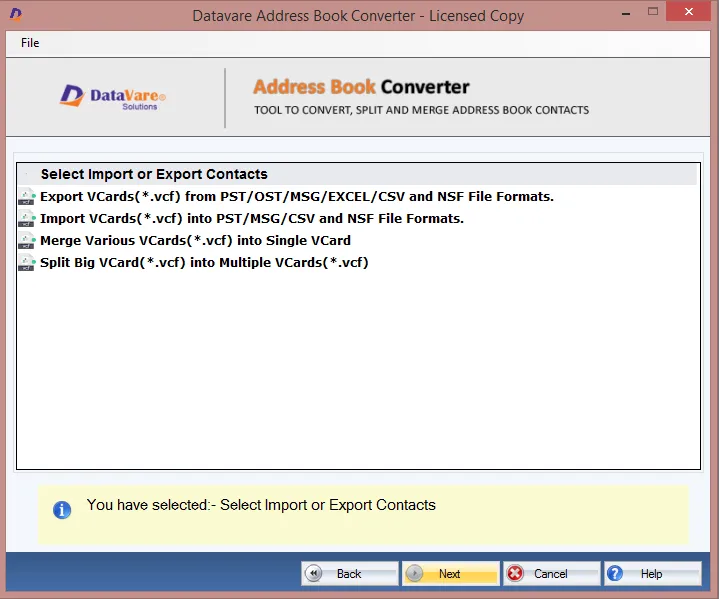
The DataVare Address Book Manager is an amazing application with excellent functionality. Leaders in the business advise using this expert’s recommended approach to transfer Excel contacts to an iPhone. Now let’s go on to the detailed method.
- Initially, there will be a “Select your Excel file that you want to convert” option. Here, you must follow the steps exactly and choose the Excel file that has to be converted to a VCF file type.
- You must choose the location from the “Select location folder to save your Excel contacts as vCards.” list below the previous choice for where the converted files will be saved.
- To convert all of the contacts at once, you must now “check-mark” the option labeled “Save all contacts in one VCF file.” Alternatively, you can leave this option “unchecked” and convert each contact.
- You can conduct the field mapping of your data according to your needs in the “Contact Fields Mapping” section.
- You are presented with the choice to “Set vCard Encoding” after the previous step. Multiple encoding formats, including ASCII, UTF-8, Unicode, UTF-32, and UTF-7, are known for picking here. You can leave it at the ‘Default’ option if you don’t need any of them.
- Click “Convert” now, then watch for the conversion procedure to be complete.
- Your files will be saved to the location you once chose.
You now have two options for sending it to the iPhone:
- With iCloud
- Using iTunes
Any of them can be selected, and it can be handled in the same manner as previously demonstrated.
The most popular method for importing contacts from Excel into an iPhone is this one. The next section lists the advantages of applying this strategy.
Use iCloud to Import Excel Contacts to Your iPhone.
- Visit iCloud.com, log in using your Apple ID, and passcode.
- To import contacts into your iPhone from the Excel sheet, click the Contacts icon.
- Click the Gear Icon in the lower right corner and select “Import vCard.”
- Simply choose the Open button from the location where the VCF file is kept now.
- Every contact will be uploaded and show up for you.
- Navigate to the Contacts area on your iPhone.
- You can see the imported contacts from Excel on your iPhone with ease after the iCloud account synchronizes with it.
Read this Post: Professional Approach to Convert/Export vCard Contacts to CSV
Use iTunes to import Excel contacts to your iPhone.
- Launch Outlook.
- Navigate to File from the top left corner, and select Open & Export.
- Select the Import/Export menu item.
- Go to Import on a different file or application now.
- Press the next button.
- Click Next after selecting the CSV option.
- Double-tapping the converted CSV file must be done after finding it.
- Select the Excel import folder. (The Contacts folder is chosen by default.)
- Select Next.
- After completing your field mapping, select Finish.
- Now use USB to connect your iPhone to your local computer.
- Open the iTunes software.
- The iPhone device name would appear in the iTunes app’s upper right corner.
- Select the “Sync with Contacts” option now.
- After selecting the Apply option, press “Sync.”
In Summary!
We’ve covered both an automatic and a manual method for importing Excel contacts onto an iPhone in this technical blog. Both of them are effective; however, we advise using the automatic solution with the iCloud technique if you would like to get a second opinion.
Read this Post: Can Thunderbird (MBOX) Export to PST?